- Quick Tips
- Take in Everyday Differences
- Experience a Capsule Hotel
- Behold the Imperial Palace Gardens
- Venture to Tokyo Station & Ramen Street
- Visit Historic Asakusa
- Stroll around Ueno Park
- Summary
We spent 23 dreamlike hours in Tokyo en route to Bangkok as part of an excellent ANA plane ticket deal that included a stopover. Disoriented by our long flight from Chicago O’Hare, entranced by the abundance of delicious street food and fantastic restaurants, and enchanted by the fusion of the modern and the traditional, we explored a small bit of this massive city. Below, read what we did and our recommendations for a similar stopover.
This is all just the tip of the iceberg—we hope to return to Japan someday to experience much more of both Tokyo and other parts of the country!
Quick Tips
| Where We Stayed | Getting Around | What to Do | Don’t Miss… |
| Nine Hours – Otemachi (capsule hotel chain) | Trains (buy an IC Card at an airport kiosk) and walking | – Imperial Palace Gardens – Asakusa Neighborhood -Uena Park | – Eating street food – Stopping by 7/11 – Taking some time to wander without a clear goal |
Take in Everyday Differences
Admire the Toilets (No, Really!)
Upon our arrival at Haneda International Airport, a swarm of helpful airport employees dressed in pink jackets approached to help us through Immigration and Customs. After completing a series of forms, we made it to the baggage claim area.
Then came the first bit of culture shock—the toilets! The airport stalls felt secure and private, and the toilets included bidets with adjustable pressure, relaxing music, and a personal deodorizing feature.
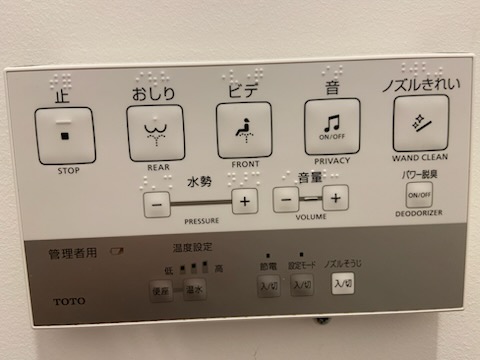
You can learn a lot about a culture from its toilets. How important are health, hygiene, and cleanliness? To what extent is privacy valued? Are there communal spaces that point to societal priorities?
As we continued our exploration of a small slice of Tokyo, we experienced traditional squat-style toilets as well as innovative facilities with heated, self-sanitizing seats, reflecting the juxtaposition of modernity and tradition in Japan. (At the top of our list for our next visit to Japan is the Toto Museum in Fukuoka, which has an exhibit that “sheds light on the historical developments that have made Japan the pinnacle of the toilet world.”)
After our first revelatory Japanese Toilet Experience ™ we drowsily but blissfully hopped on the Tokyo Rail toward Kanda Station in Chiyoda City, where we would get a bit of shut-eye. But first, we had to stock up on snacks…
Visit a 7-Eleven (or Two, or Three, or Twelve)
A handful of friends and travel blogs recommended visiting 7-Eleven in Japan. We don’t frequent 7-Eleven in the U.S. and didn’t truly understand the experience we were in for when we stepped into one of these convenience stores close to our hotel to fuel our sightseeing.
Dear readers, we were in for a treat! 7-Eleven is so much more than a convenience store. It’s a place to withdraw cash, send packages, print documents, pay bills, and even receive information and convene following natural disasters. Open 24 hours, it caters to the long working hours in Japan. And you can find a store at just about every turn; there are over 60,000 7-Elevens in the country!
The rise of one-stop-shop convenience stores like 7-Eleven has been partially attributed to the ongoing demographic transition in Japan. An aging population means that the workforce is shrinking, so such stores have absorbed some of the duties of print shops, post offices, and banks. 7-Eleven is also using and developing automations such as customer service and cleaning robots in some locations.
We did not come into contact with any such robots. Instead, a friendly cashier bowed slightly to us as we unloaded our armfuls of treats.
The pre-packaged food was *chef’s kiss*. We loved the onigiri (rice balls wrapped in crispy seaweed), self-serve smoothie station, and melonpan (sweetbread coated in crumbly cookie dough; watch how it’s made on 7-Eleven’s highly entertaining YouTube account).
You can drool over more products here (and we recommend watching these videos about how to buy various things at 7-Eleven; they’re very endearingly geared toward foreigners.)
Hit up a Vending Machine (or Two, or Three, or Twelve)
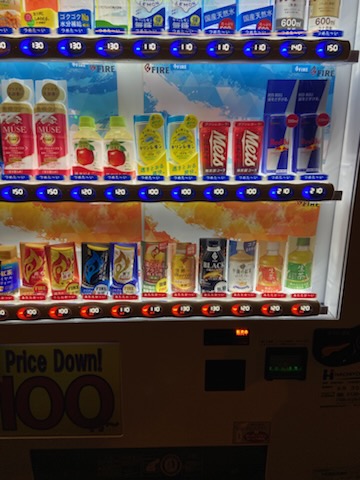
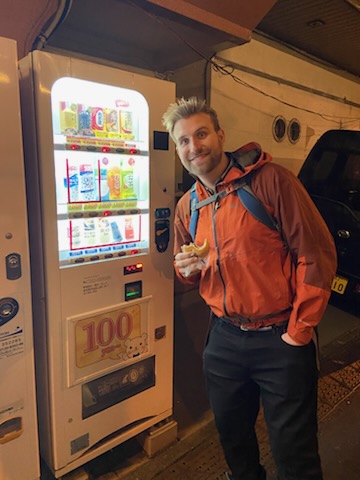
We continued down a pedestrian street bathed in neon light. Outside of our hotel, we were delighted to find a vending machine that sold hot tea and booze. (It would be the first of many such delights.)
Vending machines are ubiquitous in dense urban areas where they can be squeezed into small spaces and convenience is valued.
We also saw temperature controlled vending machines with ice cream, ready-to-enjoy-ramen, and a variety of sweet treats. We’ve read reports of other vending machines that offer cake in a can, insects, and bananas (as well as memorabilia and novelty items.) Another thing to add to the list for our next visit!
Experience a Capsule Hotel
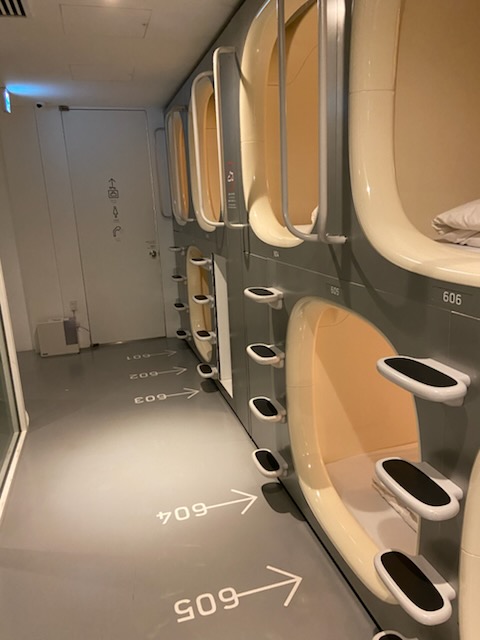
Our stomachs full, we headed into our capsule hotel. For the uninitiated, capsule hotels offer guests small, bed-sized rooms, or “capsules.” The first capsule hotel opened in 1979 in Osaka and was designed as a refuge for workers who were toiling away in their offices long after the last train home.
Now, capsule hotels are also the perfect accommodation for budget travelers and those who don’t plan on hanging out in their hotel rooms during the day.
We selected 9 Hours Otemachi-Imperial Palace because of its prime location: it’s close to the East Garden of Imperial Palace, the National Museum of the Imperial Collections, the National Museum of Modern Art, and Tokyo Station. But there are many wonderful looking options to pick between when choosing a capsule hotel. For example, we’d love to stay at Book and Bed, where visitors can sleep amongst books, at some point.
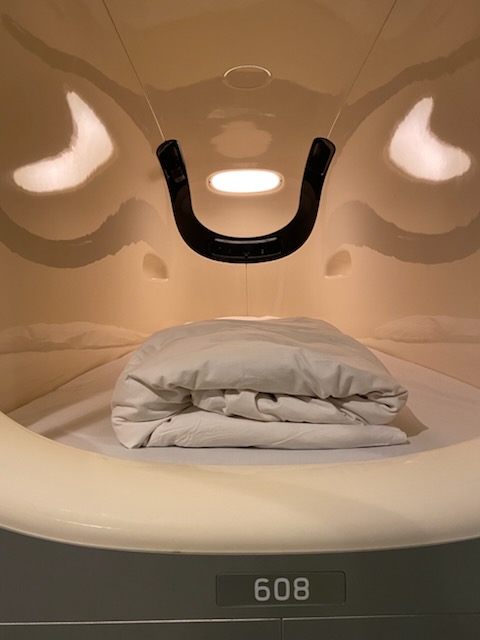
When we checked into 9 Hours, we got a toothbrush, toothpaste, towels, pajamas, and slippers as well as a key to a locker to stow our luggage. Men and women are directed to separate floors, where there are shared bathrooms opposite dormitory-style rooms with rows of capsules to sleep in. We found our respective capsules and climbed in to find a surprisingly roomy, Blade Runner-esque space with with dimmable lights, outlets, a pillow, a duvet, and a screen door. Alex is 6’5″ and found the space comfortable.
Other visitors were incredibly quiet but arrived and departed throughout the night and early morning. That said, Laura had the pleasure of listening to a drunk woman stumbling into her room around 3:30 AM and vomiting. (To her credit, she was very tearful and apologetic. Here’s hoping she had a full night of sleep and that she awoke without a hangover.)

Behold the Imperial Palace Gardens

After a few fitful hours of sleep, we woke up around 4:30 AM, showered, and checked out of Nine Hours. From there, we walked to Imperial Palace East Gardens, where Edo Castle was once located. The park would not open until 9 AM but looked lovely. It’s free and open to the public on the weekend and Tuesday—Thursday. We were able to catch some beautiful views through Otemon Gate.
The dark streets were quiet except for several ambitious runners whizzing by. We continued on to Tokyo Station, about a 10-minute walk from the gardens, wandering through the glitzy Marunouchi Business District and stopping for some early breakfast and coffee at (where else?!) 7-Eleven, our new fave.
Venture to Tokyo Station & Ramen Street
Toyko Station is a central transportation hub with a labyrinth of souvenir stores and restaurants. The Tokyo Station City complex boasts so many shops that a visitor could easily spend a full rainy day exploring its offerings.
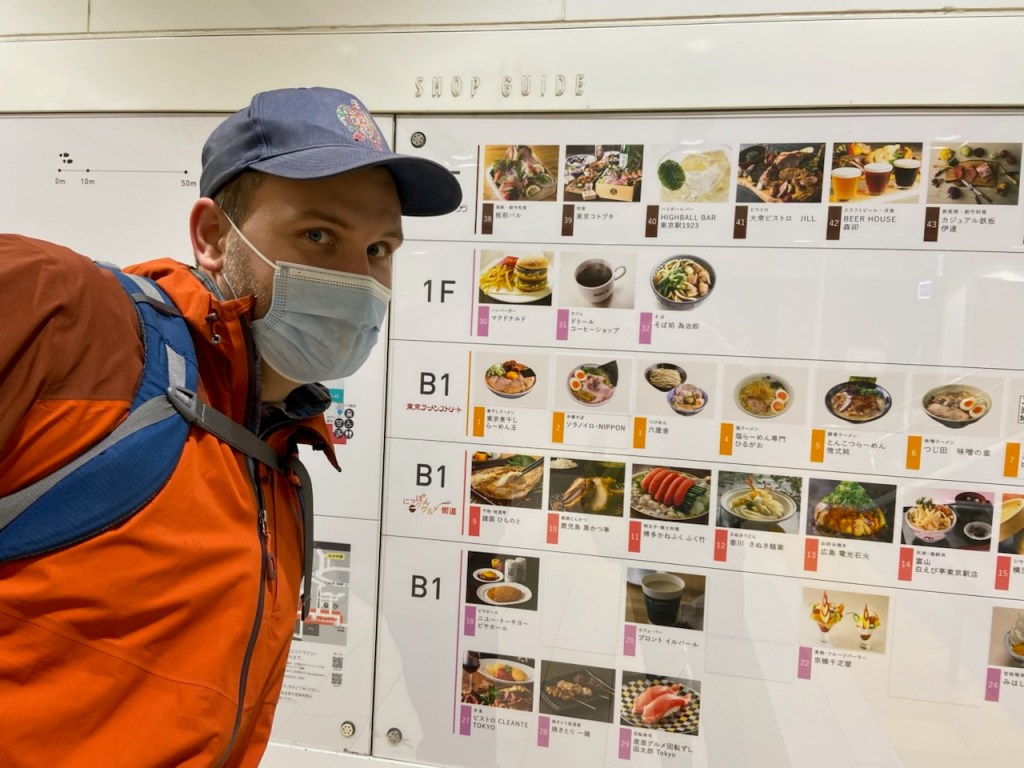
We passed by Tokyo Ramen Street, which has an extensive collection of ramen restaurants, each with its own twist on the classic comfort food. It was too early to eat, but we ogled the menus and items on display before making our way to the Asakusa District.
Visit Historic Asakusa
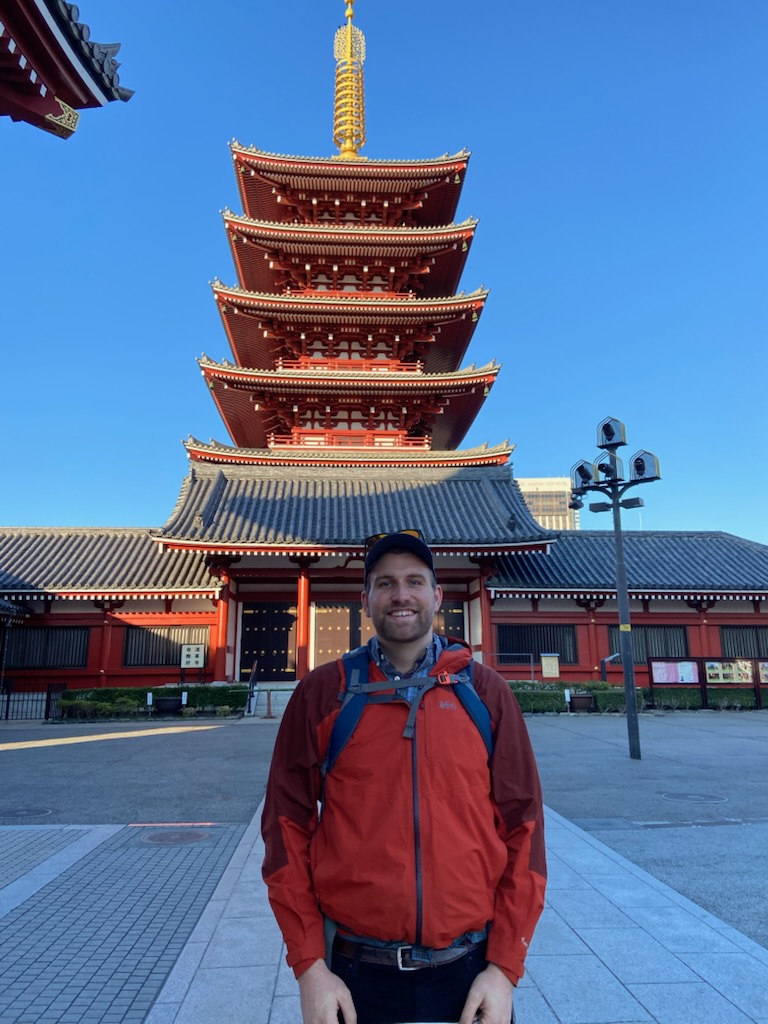
Asakusa is a historic area with Sensoji Temple (Tokyo’s oldest and most famous temple) and twisting streets with wonderful street food.
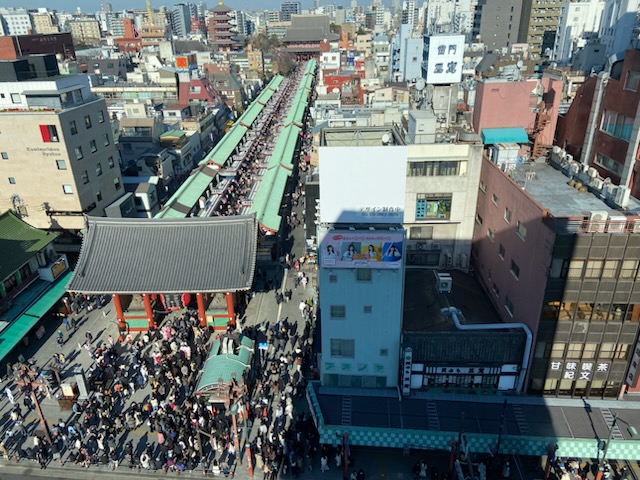
First, we recommend getting oriented at the Asakusa Culture Tourist Information Center. A kind woman gave us tips about what to see in Asakusa and suggested we go to Ueno that afternoon. Then, we ascended to the eighth floor, where there’s a great view of Kaminari Gate and Sensoji Temple.
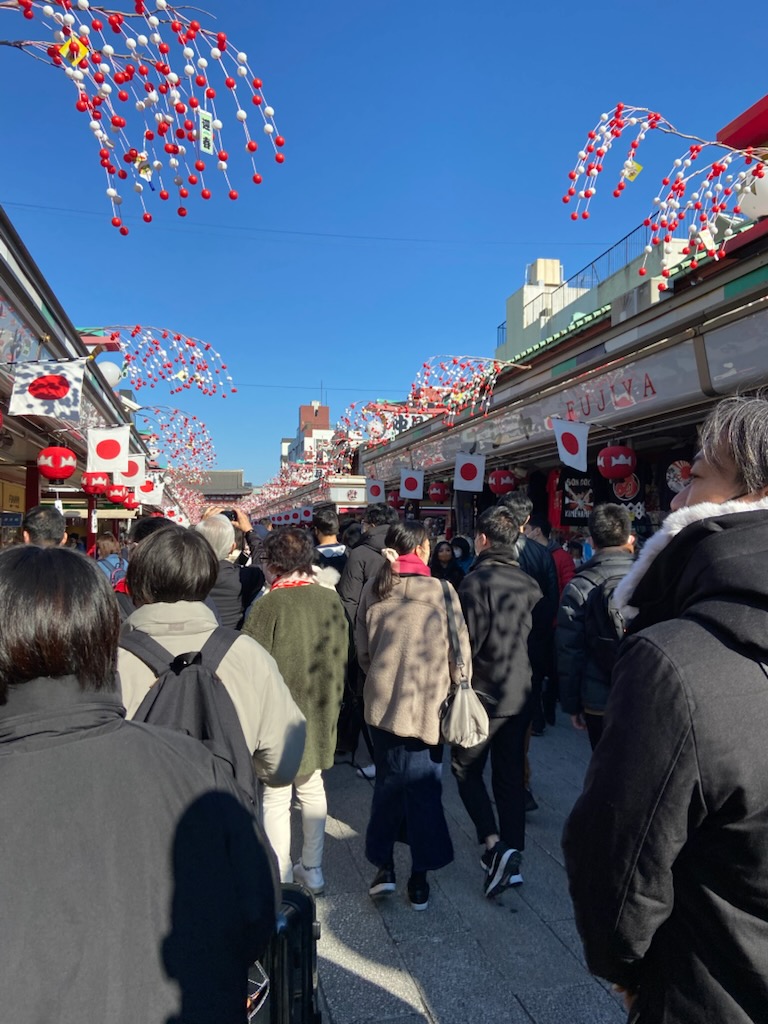
Constructed in the 7th century, the Buddhist temple is dedicated to Kannon, the goddess of mercy. Visitors enter through Kaminari Gate and stroll 200 meters down Nakamise, a bustling shopping street. It’s a popular tourist destination, and we were there on a national holiday, Coming of Age Day (Sejin no Hi), so there was an abundance of visitors.
Coming of Age Day is held on the second Monday of January, when 18-year-olds attend a ceremony at city hall followed by family events, parties, and visits to shrines. (In April 2022 the age of adulthood was lowered from 20 to 18.) We saw large groups of young women (and some men) in traditional clothing.
After checking out a series of monuments and a zen garden teeming with koi and carp, we walked along the Sumida Riverwalk. The park has over 700 cherry trees. A different type of “tree,” the Tokyo Sky Tree is the world’s tallest tower at 634 meters high. It dominates the horizon.
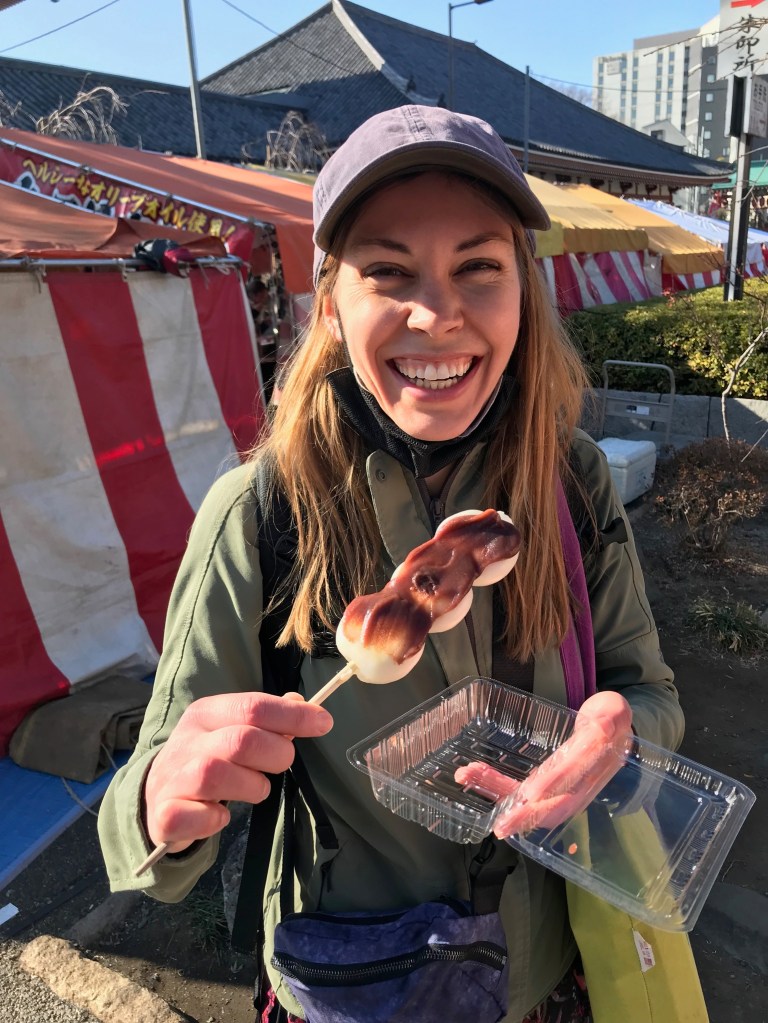
Back by Sensoji Temple, we sampled some street food: fried udon noodles with coffee, octopus yakitori (fried meat on a stick), and a rice dough skewer with sweet red bean paste. We also stopped at a sushi place for a roll (with avocado, salmon, yam, and Welsh onion) and some green tea.

Stroll around Ueno Park
Following the recommendation we got at the tourist information center, we ventured to the Ueno district. It’s about a 30-minute walk from Asakusa, but since we were short on time, we hopped on a train.
Ueno is less historic than Asakusa but lots of fun to explore. We spent our remaining time in Tokyo strolling around Ueno Park, a huge space that is home to Ueno Zoo, a massive peony garden, Toshogu Shrine, and a handful of museums. At Toshogu Shrine, a Shinto shrine with intricate gold carvings, we happened upon a kagura dance with taiko drums and flutes, performed for deities.
There was also a festival, Oyster Fest, and a youth baseball game taking place. After a bit more exploring, it was sadly time to head to the airport. We flew out of the other major airport in the Tokyo area, Narita, and took an express train from Ueno with plenty of time before our flight to Bangkok to spend the rest of our yen on vending machine fare. 😉
Summary
Our 23 hours in Tokyo were a blast, and undoubtedly not enough time to do everything we wanted to do. That being said, if you have the chance to do a stopover in Tokyo, we highly recommend taking advantage of it—and making sure you arrive with a big appetite!
Is there anything else we should be sure to do in Tokyo next time around? Do you have any favorite toilet features, vending machines, capsule hotels, or 7-Eleven treats? Let us know!

 Pass the Snacks Adventures
Leave a comment