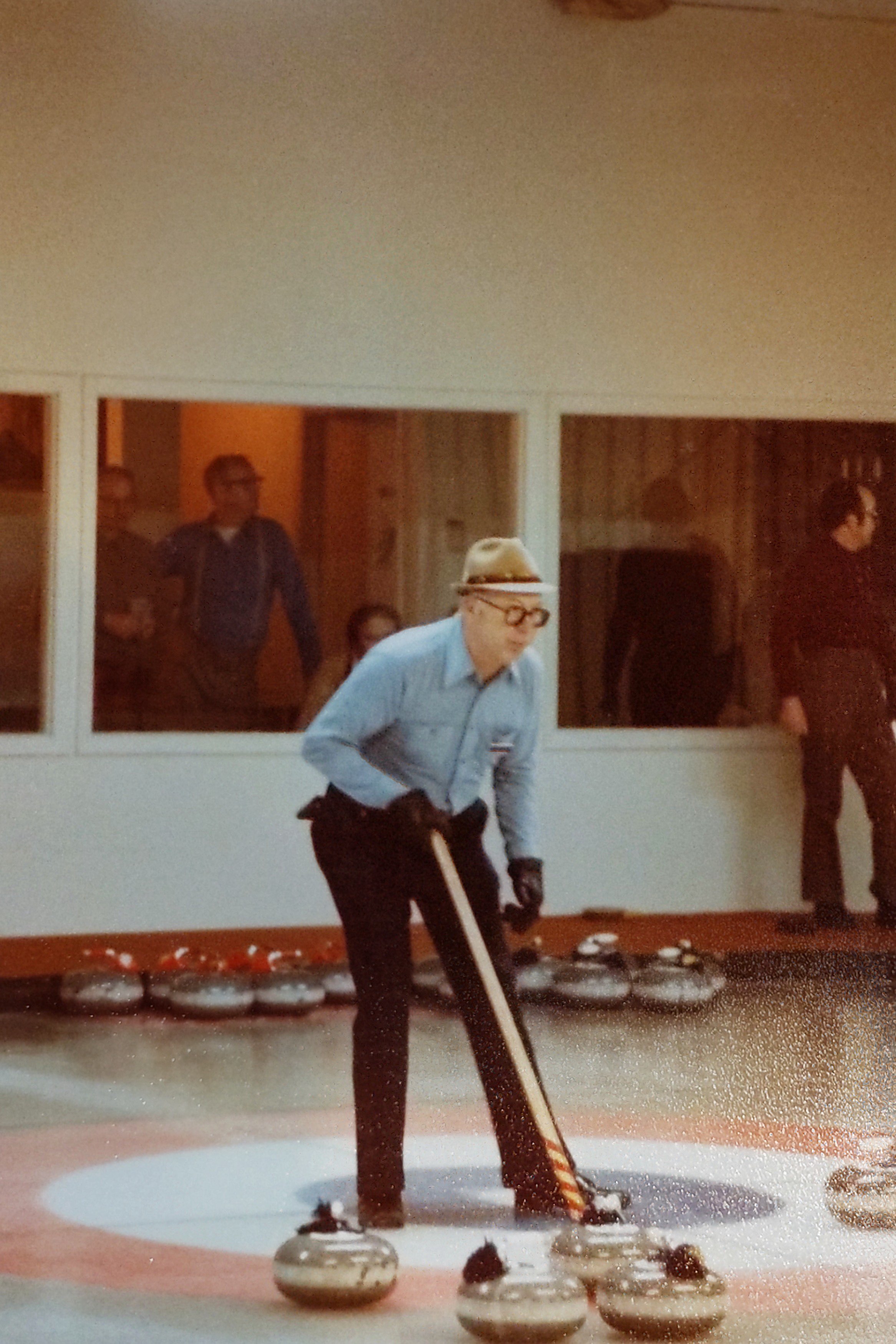
We came, we saw, we slipped. Maybe the conquering part will come later.
At a recent learn to curl event, we were deeply humbled but had a blast. Over the course of two hours, we donned slippery teflon shoe covers, lunged across a meticulously maintained sheet of ice, and slid a 44-pound stone down a 150-foot rink. Was the sport of curling more difficult and involved than we’d expected? Oh, yeah. Is it worth trying your hand at it? Definitely, and if we can do it, you can, too.
Whether you’re looking for a new hobby and tight-knit community or simply want to try something new, here’s how to get started with curling!
History of Curling
Thought to be one of the world’s oldest team sports, curling dates back to early 16th-century Scotland, where it was played on frozen lochs. During the 19th century, it spread to other countries with cold climates, including Canada, the United States, Sweden, Norway, and New Zealand.
In 1924, curling made its Olympic debut, but until 1998, it was intermittently included in this global competition. Wheelchair curling was introduced at the global stage in 2000.
Today, over 2 million people across the world are registered curlers, and World Curling (the sport’s global governing body) has 77 member associations, from Afghanistan to Qatar! In Canada, a global curling powerhouse, 1 out of every 18 people is a curler, and the US Curling Association currently has 20,000 members.

Curling 101
So how does curling work? If you’ve played shuffleboard or bocce ball before, you might know more than you think you do about curling. In a nutshell, two teams—each consisting of four players—compete to slide heavy granite stones across a sheet of ice toward a target.
Each team delivers eight stones across the rink per end (or round). After a stone is released, two people dash across the ice with brooms to sweep the ice and influence the stone’s trajectory. When throwing stones, players launch off a block, using a teflon shoe cover to help them glide across the ice in a sort of lunge. (We found this part to be much trickier than it looks!) Sweeping is also quite tricky, and involves moving at the stone’s speed across the slippery ice while vigorously brushing the ice, which actually melts it, reducing friction.
After all of the players have thrown their stones, points are awarded for those that are closest to the target. Final points are tallied after 8-10 ends are played, which typically lasts 1.5-2.5 hours.
Key Terms
Okay, time to go over a few key terms! There is A LOT of curling jargon (you can get into the weeds of it all here), but here are the most important words to know:
General
- Curling—Why is the sport called curling in the first place? When the player throwing the stone releases it, its path curves slightly. This is known as a “curl.”
- Curling club—A community organization, often a member-run nonprofit, that offers specialized curling facilities, educational opportunities, and social opportunities for all ages. Also present at most curling clubs is a kitchen, dining room, and bar.
- Bonspiel (Bahn-shpeel)—An organized curling tournament that typically lasts 2-4 days and brings together teams from different curling clubs. Spiel means “game” or “play” in Scottish Gaelic, and bon comes from the French word for “good”. Bonspiels are social and festive-feeling; the winning team typically buys the first round of drinks when a game wraps up. 🙂
Setup & Equipment
- Sheet/Rink—The icy playing surface. A rink is also the term for a curling team. For example, if the team leader (or skip) is named Curly McCurlerson, the team might be called the McCurlerson Rink.
- Stone—Heavy granite disks with handles that weigh approximately 40 pounds. They are generally sourced from the island of Ailsa Craig in Scotland and can last decades without getting damaged.
- Hack—The rubber starting block from which curlers throw or deliver the stone, and it helps curlers stay stable and gain momentum.
- End—A unit of a game; similar to a round or an inning. There are typically 8 ends in club games and 10 in Olympic games.
- The House—The scoring area at both sides of the rink. It’s got concentric circles and the center is known as the tee.
- Back Line—The line that marks the back edge of the house, and any stone that passes it is out of play.
- Broom/Brush—The tool used to sweep the ice in front of a moving stone to alter its speed and trajectory. (Got a few spare minutes? Read the Wikipedia page about the broomgate controversy of the 2015-16 season, a technology doping controversy which prompted stricter broom regulation.)
Positions
- Lead—The person on the team to release stones one and two. Their shots often determine the strategy of the rest of the game, and when the second is delivering their stones, the lead becomes one of the sweepers.
- Second—The second person on deck to release stones, or the person who delivers the third and forth stones. This player is also the vice-skip.
- Third—The person who releases stones five and six; they must be versatile and are typically one of the most well-rounded players on the team.
- Skip—The person who is the team leader and generally plays the last two stones (seven and eight). The skip also provides strategic direction to the team, calling shots and directing sweeping from the other side of the sheet.
- Sweepers—The players who move their brooms or brushes over the ice in front of a moving stone. Two players may simultaneously sweep, one on either side of the stone. The heat that sweeping generates creates a thin layer of water on the ice and reduces friction, helping the it glide. (Sweeping can be quite the arm workout, or at least we thought so!)

Learn to Curl!
Now that you know a bit about curling, here’s how to try your hand at it if you’re feeling inspired.
- Find a curling club in your area. If you live in the United States, you can search for the closest one to you here. There are many options in the upper Midwest and New England, but there are even couple of clubs in Texas and Florida! If you’re outside of the U.S., the World Curling website can point you in the right direction.
- Join a learn to curl event! Many clubs offer free or inexpensive curling classes to get more community members excited about the sport—and sometimes to recruit new members. Best of all, these classes aren’t necessarily limited to the winter. In our area, for example, some clubs host them in the late fall, while others offer them in the spring and beyond.
- Bring your tennis shoes, athletic clothing, and a good sense of humor.
- Alternatively, if you’re not quite feeling ready to try curling yourself, you can attend a bonspiel. Many are free and open to the public. This calendar is a useful place to start.
Summary
We had a wonderful, challenging time learning to curl and think you will, too!
The best part of our experience, though? Sitting down with curling club members for chips, sandwiches, and beer on tap after the curling part of our day came to an end. We heard battle stories of curling injuries and victories, got several casserole recipes (including one for Frito and green bean casserole and one for mashmallow and Fanta casserole), and jokingly rehashed the highlights and lowlights of our time on the sheet. Curling is, at its core, a convivial sport. Despite repeatedly taking tumbles across the ice and even cracking it a bit (!!), we were warmly welcomed at the club and encouraged to come back.
It’s highly unlikely that we’ll master curling the way Charlie did. At the very least, however, we have a lot more appreciation for the sport he loved so much—and the millions of curlers across the globe who dedicate themselves to it.

Have you tried curling? Did you find it as difficult and enjoyable as we did?! Let us know!



Leave a Reply