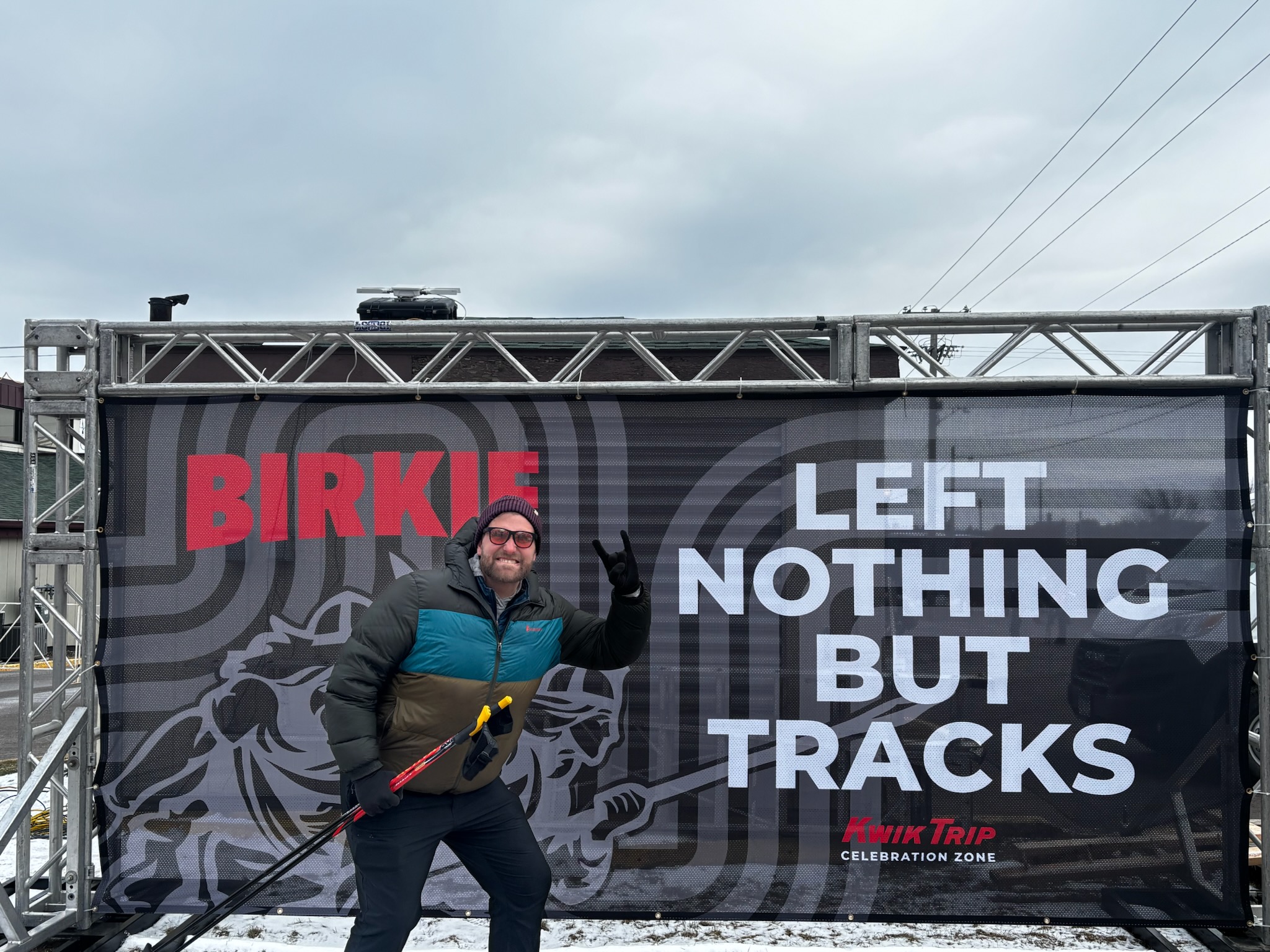
It’s the biggest ski marathon in the U.S. and the third largest in the world! The American Birkebeiner (colloquially known as the Birkie) is not to be missed. Here’s the full scoop about this one-of-a-kind event in the Northwoods of Wisconsin.
Birkie 101

In late February each year, the quiet town of Hayward, Wisconsin—a cozy corner of the Northwoods with a population of just 2,500—becomes a mecca for around twelve thousand cross countries skiers from across the globe.
The American Birkebeiner, a ski marathon, is the focal point of four days of festivities in the Hayward area, during which ten different official events are held. Skiing events begin on Wednesday with open track ski tours and continue throughout the rest of the week. Hayward city schools shut down on Friday so everyone can enjoy the carnival-like atmosphere.
Tony Wise founded this now-renowned race in 1973. Its name is a nod to the Norwegian Birkebeiner warriors Torstein Skevla and Skjervald Skrukka, who rescued baby Prince Haakon on skis during a civil war in 1206. (Nowadays, skiers can apply to the Birkebeiner Ski Association to dress up like the warriors and the prince’s mom, Inga. There is no baby involved, which is probably the right call by the race organizers!)
As you might imagine, with such a long history, there is LOTS of Birkebeiner lore. If you’re ski nerds like us, you might enjoy the very aptly named Jerome P. Poling’s new book about the history of the Birkie. (… Get it? Poling? Ski poles??)
Some juicy highlights:
- Just a few dozen entrants competed the first year of the Birkie, when not many people in the U.S. were familiar with cross country skiing. That didn’t deter Tony Wise, who raised participant levels slightly in 1974 but tripled the number of entrants in 1975 when he enticed members of the US Ski Team to show up to the race along with prominent Swedish and Norwegian athletes.
- In the early years of the Birkie, the race was held on snowmobile trails. Some skiers had barely been on cross country skis before. Some had never skied more than a few miles. Some also got lost. (One poor participant, Charles Weydt, had quite the misadventure in 1973. Wearing blue jeans and using heavy hickory skis, he took a series of wrong turns and skied an estimated 60k…but he found his way to the finish by nightfall!)
- On the now infamous day of the 1974 race, it was windy and thirteen degrees below zero at the start. A pack of rogue snowmobilers removed trail blazes and pointed one of the favorites, Don Quinn, the wrong way. Don got back on track and ended up taking second to his twin brother, Dave.
- In 1973, women were not permitted to enter the full Birkebeiner race, but Jacque Lindskoog signed up nonetheless. Although organizers told her she would not get credit for completing the race, she become the first woman to ski the Birkie. (And she beat her husband by twenty minutes!) An official women’s class was established in 1976, and Lindskoog went on to do the race for thirty-nine years.
- Today, the Birkie is a world-class race attracting professional and amateur athletes alike. (We were excited when Olympian Jessie Diggins showed up to—and won—the 50th Birkie!) Needless to say, skiers no longer get lost thanks to the impressive efforts of organizers and volunteers.
- The five-person trail grooming team works for 24 hours straight to keep tracks pristine, covering 100 kilometers.
- More than 80 truckloads of snow cover Main Street, turning it into a festive end of the race.
- Volunteers serve skiers 6,000 gallons of soup, 5,800 gallons of warm water, 24,000 sandwich cookies, 18,700 energy gels, and 5,600 bananas, among more food!
- With so many participants, there are sometimes crashes, pileups, and accidents. Poling writes, “One year…a skier doing windmills with his arms in the starting pen broke another skier’s nose. The afflicted skier completed the race with tissues stuffed intro his nostrils” (15).
Birkie Fever!


The frosty beards and eyelashes, the thumping hearts, the rosy cheeks, the enthusiasm of the crowds…Nothing beats the Birkie. This unique combination of excitement, nerves, and celebration is referred to as “Birkie fever,” a contagious zeal for sharing the trail with a kind, zany community of skiers.
But you don’t have to take our word for it.
Masses of people have returned to race year after year!
In its 53-year history, over 250,000 skiiers have participated in Birkie events. Among them is the absolutely legendary Ernie St. Germaine, who is the only person to have completed a Birkie week race for over 50 consecutive years.
Skiiers who have completed 20 or more Birkebeiners become Birchlegger Skiiers. (During the race this year, Laura asked a fellow skiier what his bib color meant, and he shared that he had done the Birkie for more than 40 years! When she said she’d like to do that some day, he responded stoically, “One year at a time.”) This year, the oldest participant was 86 years old, and skiiers have continued to race the Birkie into their 90s. (And a 3-year-old did the kids’ race!)
The enthusiastic, full-hearted participation of the masses is palpable.
This year, around 12,000 people participated in Birkie Week events, including the Barkie Birkie, an adorable skijor race, and the Giant Ski Race, which is what it sounds like—teams of six people coordinate their movements as they share a single massive pair of skis. Impressive!
The Korte vs. The Birkie

Not quite ready to commit to doing a ski marathon? Want to sleep in a bit? The Korte (short for Kortelopet) might be for you!
Both the Korte (the Birkie’s counterpart) and the Birkie are worthwhile distances on hilly, challenging courses. If you do the Korte you’ll get to plummet down many of the same steep hills that Birkie skiers do and enjoy a warm welcome to the finish line on Main Street, too.
This race generally takes place on the last Friday in February and is a very respectable 29 kilometers, or about 18 miles. Beginning in the Seeley Hills at the OO Trailhead, it goes all the way to downtown Hayward. Skiers have the option to park or get dropped off at the Birkie Ridge Parking lot and take the bus to the trailhead also enjoy aid stations at kilometers 9, 15, and 21.
You can see a Korte course map and elevation profile here.
That being said, if you have the time to train and want to experience the full Birkie, we recommend going for it at least once! The Birkie’s classic route is 53k, while the skate course is 50k. Both begin by Telemark Village in Cable. The two routes diverge early in the race before meeting up again. Seven aid stations are distributed throughout the course.
You can see a Birkie course map here and a interactive trail map here.
If You Do It (Tips & Tricks)


How to Prepare
- While it can be an investment to acquire cross country ski gear, used skis and poles can be a good bet. Stores like REI often have great deals, especially in the off-season. We’ve also seen some quality gear at our local sports stores, on e-Bay, Facebook Marketplace, and Craigslist. Talk to a sales associate or do your own research to make sure you get what you need! There are many types of skis (skate vs classic; waxable vs waxless; racing vs touring), boots (bindings and structure vary), and poles (you’ll want to be sure you’re getting the proper length for your height and technique.) This equipment guide is an excellent place to start!
- Training plans can look different based on your goals, current activity level, schedule, and snow availability. The Birkie offers sample training plans on its website. Here’s the 2026 plan, which is for 39 weeks and includes biking, strength training, and running as conditioning and cross-training activities. Try to get at least a couple long, hilly skis in over the course of the few months leading up to the race, and do what works best for you!
- What to wear for the Korte or the Birkie? We tend to dress like it’s about 10-15 degrees warmer than the actual temperature. This past year we donned short-sleeved dry-fit shirts, light jackets, ski pants/leggings, good gloves and socks, and a buff/headband. Don’t forget your sunscreen and sunglasses. The sun can be particularly dazzling it reflects off the well-groomed trail and the wind can get fierce.
- On that note, why not protect your face and look festive at the same time? Laura’s a fan of this Dermatone Face Glitter kit. It comes with two lip and face sticks, biodegradable glitter, and fun stencils. And it’s a well-known fact that glitter makes you faster (or at least helps you have more fun!)
Accommodations, Travel, & Getting to the Start Line

- Book your accommodations early! They tend to fill up over a year in advance, but we’ve had luck finding Airbnbs and cabins at resorts that are a short ways outside of Hayward. It’s extra convenient if you can find lodging a short drive from the Birkie Ridge Trailhead Parking Lot, where you’ll go to catch the shuttle to the start line.
- If possible, we also recommend finding a place with a kitchen so you have the option to cook if restaurants are busy. There’s nothing like a hearty homemade pasta dinner pre-event.
- Coming from the south, expect traffic on the way to the Birkie Ridge parking lot to be heavy. If you are arriving at Birkie Ridge from the south, plan to double the time you think you’ll need to drive, park, take the shuttle to the start, use the bathroom, and pick up your bib. (You can also pick up your bib at the expo in downtown Hayward if you have the time, but in our experience, race organizers and volunteers keep bib pickup lines moving quickly and efficiently the day of each race, so it’s worked out for us to do that.) Now for the tip to rule them all. Ten-time Birkie skier Erwan Quintin recommends using the Cable parking lot and coming from the north if possible. This is a massive time-saver; he reports that it virtually eliminates all congestion.
- Keep a close eye on when each wave is starting. You’ll need to line up in the chute a bit early. The Korte start tends to move particularly quickly. Check the signs that indicate start wave times throughout the area or ask a volunteer in a neon vest. In the warming house at the Birkie start, there’s a screen with announcements about which waves are about to start and which are on deck.
- Enjoy the start line! It’s a blast to watch the start of the elite waves and to feel the contagious energy as skiiers line up, cheering. “It’s a beautiful day to be out here,” the announcer says every year, and it’s always true.
During the Race

- At the very beginning of both the Korte and Birkie, the path can feel fairly congested, especially if you’re in the middle to later waves. This is generally not the time to pass as many people as you can or to stop in the middle of the tracks. We recommend taking your time, announcing when you’re passing someone, and being as spatially aware as possible. Inevitably, there are some big-ish crashes involving multiple skiiers, especially on some of the bigger initial hills. Be prepared to circumvent splayed-out skiiers and move to the left of the trail to make way for teams of medics on snowmobiles. And don’t worry—participants will spread out as the race continues.
- Fuel early and often! Aid stations will have water, energy drinks, bananas, cookies, and more…and they’re all handed out to skiiers in very manageable sizes. Still, it’s helpful to have some Gu packets or Honey Stinger Waffles on hand to avoid bonking. (We’re also a fan of Clif Blocks, but if you’re carrying them in an outer pocket and it’s below freezing, be sure to eat them early, or they will very likely freeze.) We tend to eat something every 3-4 miles while skiing.
- Race wisely. Erwan Quintin recommends mentally splitting the race into three parts. First, from the start to kilometer 11 (High Point), prepare for difficult terrain. Don’t go out too hard during this part. You’ll have a bit of a reprieve during the second part of the race and enjoy more gradual downhills to 35k. This is a section in which you can save some energy. Finally, at the end you can increase your pace toward the finish.
- There’s a hill 9k away from the finish line (marked 9k) that can be treacherous if conditions are icy. Sometimes skiiers remove their skis to run or walk down the side of the hill; exercise your best judgement based on your abilities and the quality of the snow.
- It all goes by fast, so remember to enjoy the scenery, thank a volunteer, and savor the rush of whizzing up and down a series of rolling hills! When you reach Hayward Lake, you’ll be at the final 5k. The music and frivolity on Main Street is well within your reach!

Tips for Spectators
- Download the Birkie app to track participants and get all of the race details you could hope for! We’ve used both Find My on our phones and the app, and the app has been more accurate.
- If you’re going with race participants to the start line to see them off, bring a backpack to store any heavy layers that they want to wear until right before they disappear in a sea of poles, hats, and buffs. They will thank you forever!
- Alternatively, skiers have the option of buying gear bags during registration, which they can stash at the start and pick up by the finish.
- It’s relatively easy to park in downtown Hayward to catch the end of the races if you arrive a bit early and don’t mind walking a few blocks. While Main Street and some of the surrounding streets will be closed to traffic, we’ve had luck around 3rd and Wisconsin.
- Have some extra time? Venture over to Hayward Lake to join fellow spectators on the ice! There will very likely be groups holding massive pictures of skiiers’ heads on sticks—and potentially some fireball shots.
- Hungry, cold, and/or under-caffeinated? Backroads Coffee on 2nd & Dakota has strong brews, burritos, pastries, and fast wifi.
- Spend some time watching race participants fly or fall down the final hill on Main Street. From there, it’s only a couple hundred meters to the finish line! (While there is some schadenfreude in the local tradition of lining the bars to watch skiiers wipe out, spectators cheer, clap, and shout encouraging words as the exhausted competitors stand up and dust the snow off their behinds…sometimes with the help of a kind volunteer nearby.)
- Got cowbells? Bring ’em!
Final Thoughts
It’s never too early to start planning for Birkie Week. Whether you’ll be cheering, racing the Barkie with a canine companion, or doing the Birkie for the first or 51st time, we hope to see you next year!
Let’s end with another song, shall we?
Do you have questions about nordic skiing or doing your first Birkie? Have Birkie stories to share? Let us know in the comments!

Leave a Reply