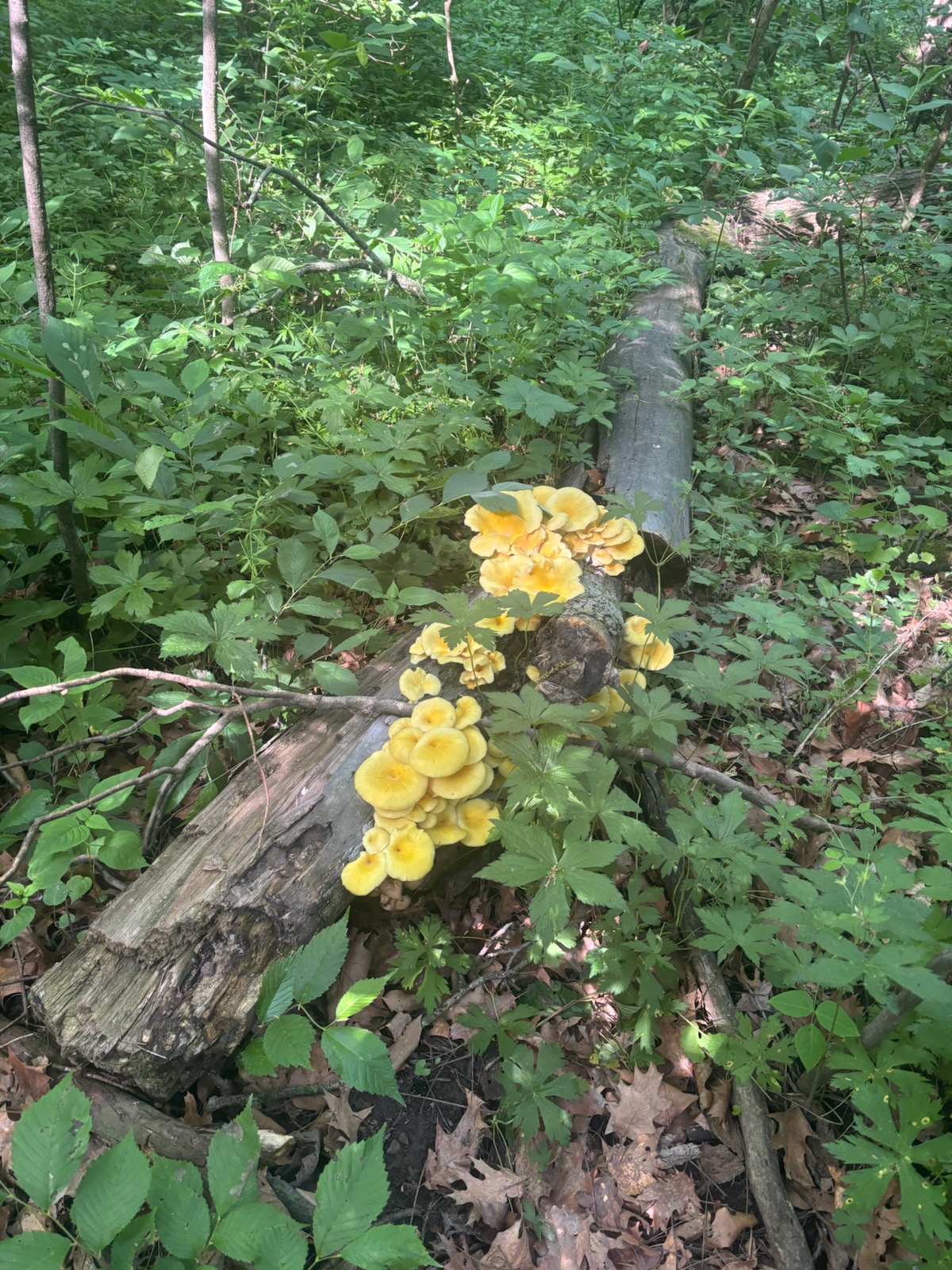
Thought to have escaped from a lab, it’s rapidly taking over the countryside, and no one can stop it.
No, we’re not talking about a new Marvel villain but the Golden Oyster Mushroom (GOM). Go for a hike in the northeastern or midwestern U.S. in the late spring and early summer and it’s likely you’ll see its butter-colored caps popping up in dense clusters.
And here’s the good news for foragers: GOM is considered to be invasive in North America, so you can pick it guilt-free. (In fact, it’s proliferating at such a quick rate that even if we all harvested it regularly we might barely make a dent.)
Without further ado, we present a short guide to the Golden Oyster Mushroom!
About the Golden Oyster
Originally from eastern Russia, northern China, and Japan, the Golden Oyster was imported into North America in the early 2000s. You may have seen it (or another oyster mushroom) being sold in supermarket grow kits. It’s relatively easy to cultivate and versatile to cook with.
GOM was first discovered growing wild in multiple US states in the 2010s and continues to expand its range. How did it first escape into the wild? There are many thoughts, ranging from an urban legend about a mushroom farm fire in Iowa to theories about the introduction of cultivated strains via grow kits and inoculated logs.
In any case, GOM is now found in 25 (most midwestern and northeastern) U.S. states and one Canadian province, and it’s lowering species richness in the forests in which it grows.
➜ Veerabahu et al investigate the impact of its rapid spread in a new Journal of Current Biology report if you’d like to dig in to the science!
When, Where, & How to Find GOM

⚠️ Before we go any further, here’s our typical warning… Remember that foraging should always be done with caution and expertise. There are old mushroom hunters, there are bold mushroom hunters, but there are no old, bold mushroom hunters.
Okay, now let’s get back to our regularly scheduled content.
When can you find GOM? Its emergence may vary, but in the Upper Midwest, mid to late May is generally prime time—and sometimes, you can continue to find and harvest it throughout the summer.
Some other GOM characteristics include:
- GOM feeds on dead or dying hardwood trees like maple, oak, and elm.
- It has a bright yellow to dark gold cap with a depressed center and is about 3/4 inch-4 inches wide.
- Its fruiting bodies grow in dense clusters.
- It has white, closely spaced gills.
- Its stem is cylindrical and often curved.
You can check out observations on iNaturalist for more photos to reference.
So you’ve found yourself some GOM, huh? If it’s still young, it’ll be the tastiest…just make sure it has caps that are about two inches wide. Although it’s still edible when old, we recommend enjoying it before the insects beat you to it.
To harvest it, use a mushroom knife or pocketknife to cut it at the base. Then, place it in a mesh, cotton, or paper bag to keep it fresh on your trip home.
Preparation & Recipe Ideas
In our opinion, although GOM doesn’t have too distinct of a flavor, it’s an enjoyable addition to the table. It has a light, slightly nutty taste and complements many meals, from toast and eggs at breakfast to risotto at dinner.
To prepare your foraged treats, slice off the GOM’s woody base, then clean it. Since mushrooms are so absorbent, we generally use a brush and small napkin to remove any debris and try to avoid using too much water. Since GOM doesn’t grow on the forest floor, it’s generally not tooooo dirty.
We had such a high volume of GOM after our recent camping bonanza, we decided to dehydrate some (and gradually rehydrate it to add it to stir-fries, curries, and pasta dishes.)
We sautéed the rest in butter with a bit of garlic. In our opinion, this is the best way to enjoy most mushrooms! Cook your GOM over medium heat for about 10 minutes until it’s a bit crispy, stirring occasionally.
You can also air fry or bake GOM, or cook clusters of GOM together like a steak. The fantastic Forager Chef has the details.


We added our crispy, garlicky GOM to the top of bowtie pasta along with some pesto, parmesan, and greens. There’s nothing like a day in the woods followed by a big meal!

Final Thoughts
We hope you enjoyed this short intro to the Golden Oyster Mushroom.
Have any questions? Have you found GOM lately? Let us know in the comments, and happy foraging!


Leave a Reply